
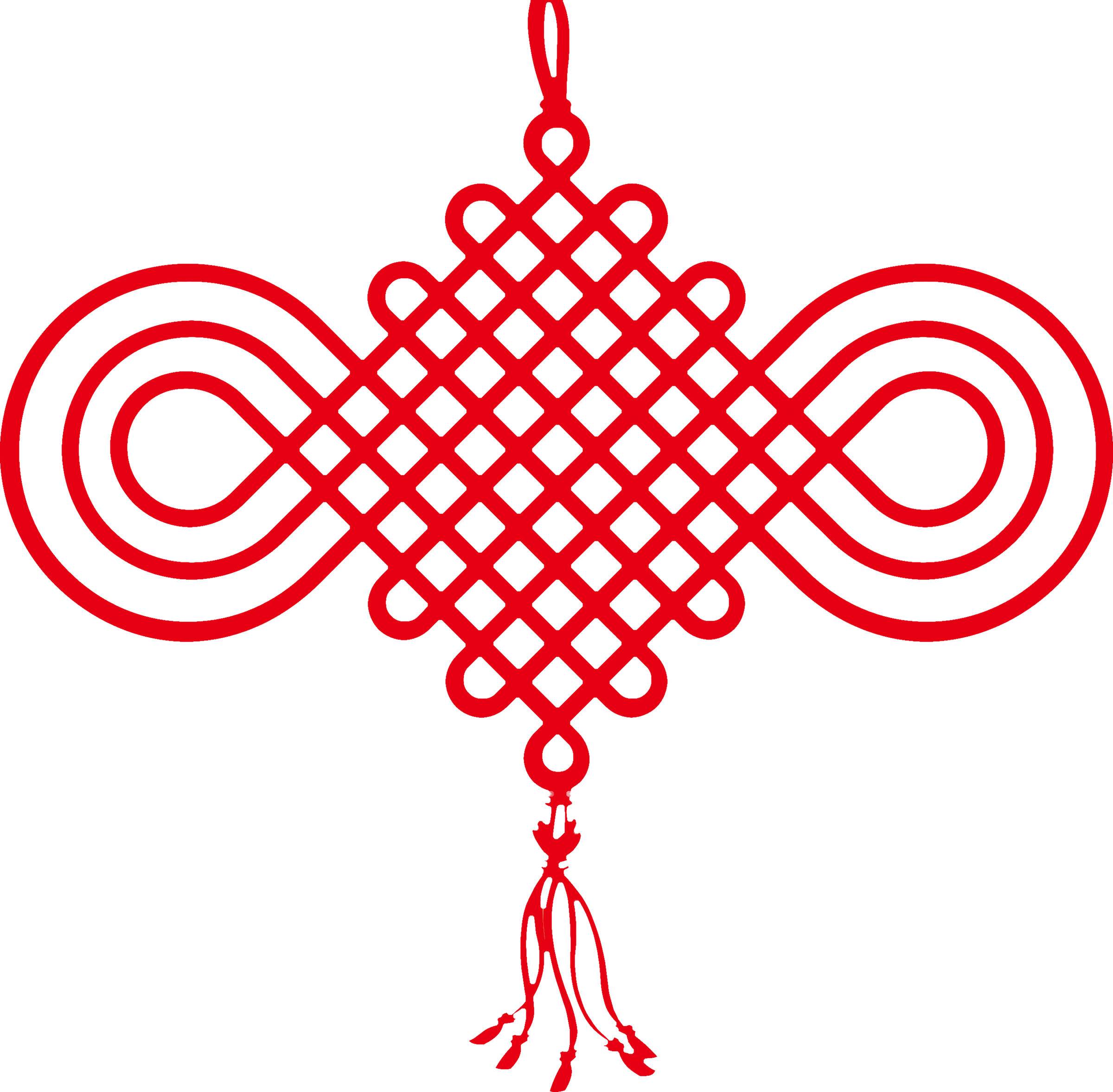
What does “endless” mean?
Follow an interlaced shape with your eyes. The cord seems to return into the pattern, guiding you from crossing to crossing rather than to an obvious end. This sense of continuity is what gives the endless knot its name.
In Buddhist tradition, the endless knot, also called pan-chang (盤長), is one of the Eight Auspicious Symbols. Its uninterrupted interlacing has been associated with the enduring Buddhist teachings. That meaning belongs to a particular tradition, with a history beyond a decorative red pendant.
A symbol and a craft
The emblem can appear as an ornamental design as well as in tied cord. A drawn lattice, a cast ornament and a handmade knot may share an interlaced appearance while differing in their materials and purpose.
The illustration here invites you to notice the pattern: a woven centre, open side loops and a short fringe. It is an illustration from our collection, rather than a historical object or a diagram of a complete tying route. Enjoy its balance without needing every crossing to carry a separate promise.
Carry a thought into your own design
For a personal card, continuity can be a gentle theme: “Always connected” or “With you through the years.” These are wishes you choose to express. If you use a religious emblem, keep its original context in mind as well.
Explore the DIY designer to arrange loops and colors, or learn the cord structure with the two-return Pan Chang lesson.